
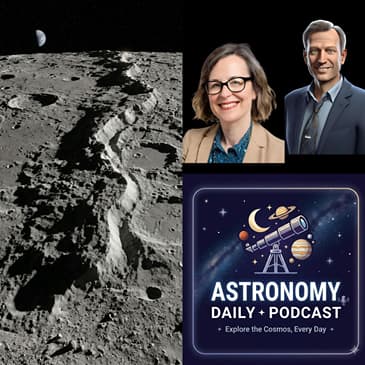

Become a supporter of this podcast: https://www.spreaker.com/podcast/astronomy-daily-latest-space-news--5648921/support.
Sponsor Details:
Ensure your online privacy by using NordVPN. To get our special listener deal and save a lot of money, visit www.astronomydaily.io/nordvpn. You'll be glad you did!
Get the best secure and private email on the planet. Stop your Government, google and who knows who else spying on every email you write. Do what we did and use ProtonMail. They beleive in privacy and there are no ads in their business model...yet they still provide a free forever service. Check them out and get out special deal at www.astronomydaily.io/protonmail
Become a supporter of Astronomy Daily by joining our Supporters Club. Commercial free episodes daily are only a click way... Click Here
This episode includes AI-generated content.
00:00:00 --> 00:00:03 Anna: Hi, everyone, and welcome back to astronomy
00:00:03 --> 00:00:05 daily. Today, 10
00:00:05 --> 00:00:08 cracks in the face of the Moon, and every one
00:00:08 --> 00:00:11 of them tells the same story. Our Moon
00:00:11 --> 00:00:13 is still shrinking, and today
00:00:13 --> 00:00:16 Avery: we know by how much. Plus, a
00:00:16 --> 00:00:18 PhD student in Sydney has drawn the first
00:00:18 --> 00:00:20 soil map of Mars.
00:00:20 --> 00:00:23 A dark energy telescope has stumbled onto a
00:00:23 --> 00:00:25 brand new comet. And two planets
00:00:25 --> 00:00:28 everyone calls twins turn out to be more
00:00:28 --> 00:00:29 like distant cousins.
00:00:30 --> 00:00:32 Anna: We'll also catch up on Japan's Phobos
00:00:32 --> 00:00:35 mission, now safely on its way, and a
00:00:35 --> 00:00:37 telescope that's turned out even sharper than
00:00:37 --> 00:00:38 its builders hoped.
00:00:39 --> 00:00:41 Avery: It's Tuesday, the 20th of October
00:00:41 --> 00:00:44 2026. This is Astronomy AstroDailyPod
00:00:44 --> 00:00:46 series five, episode 209.
00:00:47 --> 00:00:47 I'm, um, Avery.
00:00:48 --> 00:00:50 Anna: And I'm Anna. Let's get into it.
00:00:51 --> 00:00:52 Avery: Here we go then.
00:00:52 --> 00:00:54 Anna: Most of us grow up thinking of the Moon as
00:00:54 --> 00:00:56 finished, geologically dead.
00:00:57 --> 00:00:59 Everything interesting happened billions of
00:00:59 --> 00:01:02 years ago, and since then, it has just
00:01:02 --> 00:01:05 sat there collecting craters. A
00:01:05 --> 00:01:07 new study published last Wednesday in the
00:01:07 --> 00:01:09 Planetary Science Journal says that picture
00:01:09 --> 00:01:12 is wrong in a very specific, measurable way.
00:01:13 --> 00:01:16 Avery: This comes from Tom Waters, a, uh, scientist
00:01:16 --> 00:01:18 Emeritus at the Smithsonian's National Air
00:01:18 --> 00:01:20 and Space Museum with Maria Banks at NASA
00:01:20 --> 00:01:23 Goddard Corporation, Cole Knyphaver and Mark
00:01:23 --> 00:01:25 Robinson, who leads the camera on NASA's
00:01:25 --> 00:01:26 Lunar Reconnaissance Orbiter.
00:01:26 --> 00:01:29 Anna: And Robinson's name should ring a bell for
00:01:29 --> 00:01:31 regular listeners. His team's change
00:01:31 --> 00:01:34 detection work on that same camera gave us
00:01:34 --> 00:01:36 the brand new lunar crater we covered back in
00:01:36 --> 00:01:39 episode 196. So what did
00:01:39 --> 00:01:42 they find? More than 10 young
00:01:42 --> 00:01:45 faults spread right across the lunar surface.
00:01:45 --> 00:01:47 About 8 of them are what
00:01:47 --> 00:01:50 geologists call lobate scarps. And little
00:01:50 --> 00:01:53 over 2 are small ridges on the dark lunar
00:01:53 --> 00:01:54 plains.
00:01:54 --> 00:01:57 Avery: The maria paint us a picture of a lobate
00:01:57 --> 00:01:57 scarp.
00:01:58 --> 00:02:00 Anna: Imagine a cliff or a step
00:02:00 --> 00:02:03 running across the landscape. It forms when
00:02:03 --> 00:02:06 the crust is squeezed so hard it breaks and
00:02:06 --> 00:02:08 one side gets shoved up and over the other.
00:02:09 --> 00:02:11 That's a thrust fault on the Moon. They're
00:02:11 --> 00:02:14 usually tens of metres high and a few
00:02:14 --> 00:02:16 kilometres long, though the release shows one
00:02:16 --> 00:02:19 near the North Pole, inside a crater called
00:02:19 --> 00:02:22 Mouch's L, standing more than 100 metres
00:02:22 --> 00:02:22 tall.
00:02:23 --> 00:02:26 Avery: And, um, these are young. On
00:02:26 --> 00:02:28 the Moon, young is a relative word.
00:02:28 --> 00:02:31 Anna: Very relative. Young here means the last few
00:02:31 --> 00:02:34 hundred million years. The tell is that they
00:02:34 --> 00:02:36 look crisp, they cut straight through small
00:02:36 --> 00:02:38 craters, and they haven't been battered flat
00:02:38 --> 00:02:41 by later impacts over the age of the Moon.
00:02:41 --> 00:02:43 That's yesterday afternoon.
00:02:43 --> 00:02:46 Avery: So why is the Moon being squeezed at
00:02:46 --> 00:02:49 all? There's no plate tectonics up there.
00:02:49 --> 00:02:52 Anna: Exactly. And that's the key. The Moon's
00:02:52 --> 00:02:55 interior is still warm and it's slowly
00:02:55 --> 00:02:58 cooling. As rock cools, it contracts.
00:02:58 --> 00:03:00 The inside of the moon gets a little smaller
00:03:00 --> 00:03:02 and the rigid outer shell has to fit around
00:03:02 --> 00:03:05 it. Think of a grape drying into a raisin.
00:03:05 --> 00:03:08 Except the Moon's skin is brittle rock,
00:03:08 --> 00:03:11 so instead of wrinkling, it cracks and breaks
00:03:11 --> 00:03:12 along these thrust faults.
00:03:12 --> 00:03:15 Avery: And Earth tides add to it, don't they?
00:03:15 --> 00:03:18 Anna: They do. Earlier work by the same group
00:03:18 --> 00:03:21 showed the orientation of the faults.
00:03:21 --> 00:03:23 Only makes sense if you add tidal stresses
00:03:23 --> 00:03:26 from Earth on top of the global shrinking.
00:03:26 --> 00:03:28 But the shrinking is the engine.
00:03:28 --> 00:03:30 Avery: Here's the headline, then. Um, how much
00:03:30 --> 00:03:32 smaller has it gotten?
00:03:32 --> 00:03:34 Anna: The team added up how much the surface has
00:03:34 --> 00:03:36 been compressed across all of those faults,
00:03:36 --> 00:03:39 highlands and Maria together, and converted
00:03:39 --> 00:03:42 that into a change in radius. The answer is
00:03:42 --> 00:03:45 about 42 to 46 metres. The
00:03:45 --> 00:03:47 Smithsonian rounds it to 45. That's over
00:03:47 --> 00:03:50 roughly the last 400 to 800 million
00:03:50 --> 00:03:51 years.
00:03:52 --> 00:03:54 Avery: 45 metres off a radius of more
00:03:54 --> 00:03:57 than 1700 kilometres.
00:03:57 --> 00:03:58 That's tiny.
00:03:59 --> 00:04:01 Anna: It is. If the pace were steady,
00:04:02 --> 00:04:05 it works out to at most about 11 centimetres
00:04:05 --> 00:04:07 every million years. A tenth of a
00:04:07 --> 00:04:10 micrometre a year. Earth's tectonic plates
00:04:10 --> 00:04:12 move about a centimetre and a half a year,
00:04:12 --> 00:04:15 roughly the rate your fingernails grow. So
00:04:15 --> 00:04:18 the Moon is shrinking more than 100 times
00:04:18 --> 00:04:20 more slowly than Earth's plates move.
00:04:20 --> 00:04:22 Avery: And, um, this updates an older figure,
00:04:22 --> 00:04:22 doesn't it?
00:04:22 --> 00:04:25 Anna: It does. Waters team first raised
00:04:25 --> 00:04:28 this in 2010, when the orbiter's camera had
00:04:28 --> 00:04:31 turned up 14 new scarps. Back then,
00:04:31 --> 00:04:34 they offered a rough estimate of about 100
00:04:34 --> 00:04:37 metres. By 2015, the count was
00:04:37 --> 00:04:39 over 3. Now, with more than
00:04:39 --> 00:04:42 10 mapped, the number has firmed up
00:04:42 --> 00:04:45 and it's come in at less than half that early
00:04:45 --> 00:04:46 rough guess.
00:04:46 --> 00:04:48 Avery: So what's the surprise here? The Moon
00:04:48 --> 00:04:49 shrinking isn't new.
00:04:50 --> 00:04:53 Anna: The surprise is how little. Models of
00:04:53 --> 00:04:55 how the Moon should have cooled predict much
00:04:55 --> 00:04:57 more contraction than these faults record.
00:04:58 --> 00:05:01 And the team didn't find old, worn down
00:05:01 --> 00:05:03 scarps from earlier in lunar history. So
00:05:03 --> 00:05:05 it looks as if the widespread faulting
00:05:05 --> 00:05:07 started relatively late.
00:05:07 --> 00:05:10 Avery: Which means something held the heat in.
00:05:10 --> 00:05:13 Anna: That's their leading explanation. The ancient
00:05:13 --> 00:05:16 lunar crust was pulverised by billions of
00:05:16 --> 00:05:18 years of impacts into a thick, porous,
00:05:18 --> 00:05:21 heavily fractured layer called the mega
00:05:21 --> 00:05:24 regolith. Porous broken rock is a poor
00:05:24 --> 00:05:26 conductor of heat, so it may have acted like
00:05:26 --> 00:05:29 a blanket, keeping the interior warm and
00:05:29 --> 00:05:31 delaying the cooling and so delaying the
00:05:31 --> 00:05:34 shrinking. The paper also offers an
00:05:34 --> 00:05:37 alternative a strong, rigid outer
00:05:37 --> 00:05:39 shell that simply resisted breaking until the
00:05:39 --> 00:05:41 stress built past a threshold.
00:05:42 --> 00:05:44 Avery: And, um, they see a hint of that in where the
00:05:44 --> 00:05:46 faults are right.
00:05:46 --> 00:05:49 Anna: The thickest crust has the fewest faults,
00:05:49 --> 00:05:52 which also suggests those areas are the most
00:05:52 --> 00:05:53 stable.
00:05:53 --> 00:05:56 Avery: Regular listeners might feel a sense of
00:05:56 --> 00:05:57 deja vu here.
00:05:58 --> 00:06:00 Anna: Back in episode 192, we covered Mercury,
00:06:00 --> 00:06:03 where scarps were hiding under rough terrain
00:06:03 --> 00:06:05 and the planet had shrunk more than anyone
00:06:05 --> 00:06:08 counted. Here, it's the reverse. A, uh,
00:06:09 --> 00:06:11 careful count of nearly every fault finds the
00:06:11 --> 00:06:13 Moon shrank less than the theory expected.
00:06:14 --> 00:06:17 Same physics, opposite surprise. And
00:06:17 --> 00:06:19 it's a reminder we keep coming back to on
00:06:19 --> 00:06:22 this show. What you can count depends on how
00:06:22 --> 00:06:23 hard you looked.
00:06:23 --> 00:06:25 Avery: So we all need to look harder.
00:06:26 --> 00:06:28 Anna: It does. And this matters for anyone planning
00:06:28 --> 00:06:31 to live there. Waters calculates the
00:06:31 --> 00:06:33 compressional stress from this much shrinking
00:06:33 --> 00:06:36 at about 4 MPa. That lines
00:06:36 --> 00:06:38 up with the stress released in the shallow
00:06:38 --> 00:06:40 moonquakes that Apollo's seismometers
00:06:40 --> 00:06:43 recorded in the 1970s. On
00:06:43 --> 00:06:45 Earth, about 90% of seismic activity is
00:06:45 --> 00:06:48 concentrated along plate boundaries. The Moon
00:06:48 --> 00:06:51 is a single plate, so its faults are spread
00:06:51 --> 00:06:53 everywhere. Waters says the growth of
00:06:53 --> 00:06:55 existing faults and the formation of new ones
00:06:55 --> 00:06:57 is expected to continue today.
00:06:57 --> 00:07:00 Avery: So a, uh, moonquake could happen anywhere.
00:07:00 --> 00:07:03 Anna: That's the point. And we want to be careful
00:07:03 --> 00:07:05 with it. This isn't a warning that something
00:07:05 --> 00:07:08 is about to happen. It's about where
00:07:08 --> 00:07:11 you choose to put a permanent base. Waters
00:07:11 --> 00:07:13 earlier work crowned young faults near some
00:07:13 --> 00:07:15 of the candidate Artemis landing regions at
00:07:15 --> 00:07:18 the South Pole. If the thickest crust is the
00:07:18 --> 00:07:21 most stable, that's useful information for
00:07:21 --> 00:07:21 planners.
00:07:22 --> 00:07:23 Avery: What should we keep in mind?
00:07:24 --> 00:07:24 Anna: Three things.
00:07:25 --> 00:07:27 First, the rate assumes the shrinking
00:07:27 --> 00:07:30 happened at a steady pace, which it may not
00:07:30 --> 00:07:32 have. Second, the ages of these
00:07:32 --> 00:07:35 faults are relative. They come from how crisp
00:07:35 --> 00:07:38 they look and what they cut across, not from
00:07:38 --> 00:07:40 dated samples. And third, the
00:07:40 --> 00:07:42 moonquake point is about sighting and
00:07:42 --> 00:07:44 engineering, not prediction.
00:07:44 --> 00:07:46 Avery: And there's no Australian team on this one?
00:07:47 --> 00:07:49 Anna: No, and we won't pretend otherwise.
00:07:50 --> 00:07:52 But the Moon is the one world every listener
00:07:52 --> 00:07:55 can step outside and see north or south.
00:07:56 --> 00:07:58 Tonight's waxing gibbous will be up in the
00:07:58 --> 00:08:00 evening sky from Sydney to London.
00:08:01 --> 00:08:03 And somewhere on that face too small to
00:08:03 --> 00:08:05 see, a, uh, fault might be
00:08:05 --> 00:08:08 Avery: growing, staying in the solar system.
00:08:08 --> 00:08:11 And a story from right here in Sydney. If
00:08:11 --> 00:08:13 people are ever going to grow food on Mars,
00:08:13 --> 00:08:15 they'll need to know what they're growing it
00:08:15 --> 00:08:17 in. The University of Sydney has just
00:08:17 --> 00:08:19 produced the first comprehensive
00:08:19 --> 00:08:21 classification and map of Martian soils.
00:08:21 --> 00:08:22 Anna: Who's behind it?
00:08:23 --> 00:08:25 Avery: PhD student Daniel Irving from the Sydney
00:08:25 --> 00:08:27 Institute of Agriculture, working with
00:08:27 --> 00:08:30 Professor Alex McBratney, one of the world's
00:08:30 --> 00:08:33 leading soil scientists. The
00:08:33 --> 00:08:36 paper is in the soil science journal Ktena,
00:08:36 --> 00:08:38 went online at the start of this month, and
00:08:38 --> 00:08:39 the university announced it on Friday.
00:08:40 --> 00:08:42 Anna: And they've had to invent a word
00:08:43 --> 00:08:44 they have.
00:08:44 --> 00:08:46 Avery: On Earth, we talk about soils, but, uh,
00:08:46 --> 00:08:49 they've proposed calling Martian soil classes
00:08:49 --> 00:08:51 Areths, from Ares, the Greek name for
00:08:51 --> 00:08:54 Mars. The System groups almost 800
00:08:54 --> 00:08:57 million locations into a hierarchy. Ten
00:08:57 --> 00:08:59 broad realms, 100 assemblages
00:09:00 --> 00:09:03 and 2 detailed forms. The
00:09:03 --> 00:09:05 map covers 92% of the planet, based
00:09:05 --> 00:09:08 on what? Orbital observations
00:09:08 --> 00:09:11 and models of properties like texture,
00:09:11 --> 00:09:14 mineralogy, ph, and how deep the soil
00:09:14 --> 00:09:17 goes. As a test, they scored all
00:09:17 --> 00:09:20 2000 forms on how well they might support
00:09:20 --> 00:09:23 plants. One called Nohi
00:09:23 --> 00:09:24 Barreth, came out on top at
00:09:24 --> 00:09:26 0.93 out of 1.
00:09:27 --> 00:09:30 Its mottled profile is about 72%
00:09:30 --> 00:09:33 clay, with a pH of 6.8, which
00:09:33 --> 00:09:36 is close to neutral. It turns up in
00:09:36 --> 00:09:39 the mid latitudes around Tharsis
00:09:39 --> 00:09:42 Arabia Terra and Elysium Planitia,
00:09:42 --> 00:09:45 but on only 0.14% of the
00:09:45 --> 00:09:45 surface.
00:09:46 --> 00:09:49 Anna: So the Martian potato patch.
00:09:50 --> 00:09:53 Avery: Not quite. And the team is clear about that.
00:09:53 --> 00:09:56 These are candidate areas for closer study,
00:09:56 --> 00:09:59 not greenhouse sites. Nobody's going to plant
00:09:59 --> 00:10:01 crops straight into Martian dirt. Any habitat
00:10:01 --> 00:10:03 will need controlled environments, water,
00:10:04 --> 00:10:06 nutrients and treatment for harmful
00:10:06 --> 00:10:08 chemicals. In fact, the map doesn't yet
00:10:08 --> 00:10:11 include perchlorate, the toxic salt found
00:10:11 --> 00:10:14 across Mars, or nitrogen. And many of
00:10:14 --> 00:10:16 the Sol properties are inferred from orbit,
00:10:16 --> 00:10:19 so the classification will change as rovers
00:10:19 --> 00:10:20 measure more.
00:10:20 --> 00:10:23 Anna: What's the limiting factor for plants?
00:10:23 --> 00:10:25 Avery: Water holding capacity in
00:10:25 --> 00:10:28 73% of the forms they assessed.
00:10:28 --> 00:10:31 The next up is back on Earth, mixing Mars
00:10:31 --> 00:10:34 like substrates for the promising classes and
00:10:34 --> 00:10:35 growing crops in them under controlled
00:10:35 --> 00:10:36 conditions.
00:10:36 --> 00:10:39 Anna: And there's a payoff for Australia, too,
00:10:39 --> 00:10:40 there is.
00:10:40 --> 00:10:43 Avery: Martian soils have no organic matter,
00:10:43 --> 00:10:46 and McBratney points out that some of Earth's
00:10:46 --> 00:10:48 toughest arid soils have very little either.
00:10:49 --> 00:10:51 The work may help scientists think about
00:10:51 --> 00:10:53 places like the Pilbara and the Atacama
00:10:53 --> 00:10:56 differently. Mars as a lens on our own red
00:10:56 --> 00:10:57 dirt.
00:10:57 --> 00:11:00 Anna: Next, here's a discovery made almost
00:11:00 --> 00:11:02 by accident. The European Space
00:11:02 --> 00:11:05 Agency's Euclid telescope is built to map
00:11:05 --> 00:11:08 billions of galaxies so astronomers can study
00:11:08 --> 00:11:10 dark matter and dark energy. It is
00:11:10 --> 00:11:13 emphatically not a comet hunter. Yet
00:11:13 --> 00:11:15 ESA announced yesterday that Euclid has
00:11:15 --> 00:11:18 discovered its first previously unknown
00:11:18 --> 00:11:18 comet.
00:11:19 --> 00:11:22 Avery: How does a galaxy telescope trip over a
00:11:22 --> 00:11:22 comet?
00:11:23 --> 00:11:25 Anna: Through a, uh, PhD student and some clever
00:11:25 --> 00:11:28 software? Miko Poynton at the University
00:11:28 --> 00:11:31 of Helsinki wrote a programme to spot
00:11:31 --> 00:11:33 moving solar system objects in Euclid's
00:11:33 --> 00:11:36 images, mainly so they can be cleaned out of
00:11:36 --> 00:11:39 the galaxy data. In images taken between the
00:11:39 --> 00:11:42 16th and 24th of September, his software
00:11:42 --> 00:11:44 flagged a streak smeared across several
00:11:44 --> 00:11:47 frames. He tracked it into five image
00:11:47 --> 00:11:50 sets, 16 exposures in all, and found a
00:11:50 --> 00:11:52 fuzzy cloud around it. That's a, uh, coma.
00:11:52 --> 00:11:55 The sign of an active comet shedding dust and
00:11:55 --> 00:11:55 gas.
00:11:56 --> 00:11:57 Avery: And it checked out?
00:11:57 --> 00:12:00 Anna: No, no match in any catalogue. It was
00:12:00 --> 00:12:02 reported to the International Astronomical
00:12:02 --> 00:12:05 Union's Minor Planet Centre. Global ground
00:12:05 --> 00:12:07 based observers followed up and it was
00:12:07 --> 00:12:09 confirmed as a comet on 8th October.
00:12:09 --> 00:12:11 It's now officially C
00:12:12 --> 00:12:14 2026 S1 Euclid.
00:12:15 --> 00:12:15 Avery: Where is it?
00:12:16 --> 00:12:19 Anna: About 1.3 billion kilometres from Earth,
00:12:19 --> 00:12:21 roughly between the orbits of Jupiter and
00:12:21 --> 00:12:24 Saturn. But it isn't in the plane of
00:12:24 --> 00:12:26 the planets. From the sun's point of view,
00:12:26 --> 00:12:29 it's almost straight up on a steep orbit
00:12:29 --> 00:12:31 that takes thousands of years to complete.
00:12:32 --> 00:12:33 Avery: Why is that a lucky catch?
00:12:34 --> 00:12:36 Anna: Because Euclid deliberately avoids the band
00:12:36 --> 00:12:38 of sky along the plane of the solar system,
00:12:38 --> 00:12:40 where comets and asteroids are most common,
00:12:41 --> 00:12:43 since the dust there adds glare and it
00:12:43 --> 00:12:45 usually photographs each patch of sky only
00:12:45 --> 00:12:48 once. So a comet has to wander through the
00:12:48 --> 00:12:51 right field at the right time. Euclid archive
00:12:51 --> 00:12:54 scientist Bruno Altieri called it a happy
00:12:54 --> 00:12:54 coincidence.
00:12:55 --> 00:12:57 Avery: Any bigger significance?
00:12:57 --> 00:13:00 Anna: Two things. It was a real world test of how
00:13:00 --> 00:13:02 Euclid could alert ESA's future Comet
00:13:02 --> 00:13:04 Interceptor mission to a fresh target.
00:13:04 --> 00:13:06 Although this particular comet isn't a
00:13:06 --> 00:13:09 candidate and it's a nice reminder of
00:13:09 --> 00:13:12 something we often say on this catalogues are
00:13:12 --> 00:13:15 detection limits, not censuses. One honest
00:13:15 --> 00:13:17 note for southern listeners, it was found in
00:13:17 --> 00:13:19 Euclid's DEET field north, and it's far too
00:13:19 --> 00:13:21 faint to see without a big telescope.
00:13:21 --> 00:13:24 Avery: Uranus and Neptune are usually described
00:13:24 --> 00:13:27 as twins. Similar size, similar
00:13:27 --> 00:13:30 mass, both blue green ice giants.
00:13:31 --> 00:13:33 But a study in Astronomy and Astrophysics,
00:13:34 --> 00:13:36 published in its final form yesterday, argues
00:13:36 --> 00:13:39 their chemistry tells a different story.
00:13:39 --> 00:13:40 Anna: Who's behind it?
00:13:41 --> 00:13:44 Avery: Tom Briand at Aix Marseille University with
00:13:44 --> 00:13:46 Vincent Hu, Olivier Moussi of the Southwest
00:13:46 --> 00:13:49 Research Institute, Thibaut Cavalier and
00:13:49 --> 00:13:51 colleagues.1 Disclosure. The
00:13:51 --> 00:13:54 accepted version of the paper has been online
00:13:54 --> 00:13:56 since late August, so this is the journal
00:13:56 --> 00:13:57 publication rather than a
00:13:57 --> 00:14:00 Anna: brand new result, though, how do you
00:14:00 --> 00:14:03 measure what's deep inside a planet with no
00:14:03 --> 00:14:03 surface?
00:14:04 --> 00:14:06 Avery: Indirectly using carbon monoxide.
00:14:07 --> 00:14:09 Deep down, where it's hot. Carbon monoxide is
00:14:09 --> 00:14:12 created from methane and water. Strong
00:14:12 --> 00:14:15 vertical mixing carries it up to the upper
00:14:15 --> 00:14:17 atmosphere faster than it can be destroyed.
00:14:17 --> 00:14:20 So the amount we see up top acts as a
00:14:20 --> 00:14:23 tracer for the oxygen hidden far below.
00:14:23 --> 00:14:25 The team used measurements of that carbon
00:14:25 --> 00:14:28 monoxide, including from the ALMA array in
00:14:28 --> 00:14:30 Chile's Atacama Desert, and fed them into
00:14:30 --> 00:14:33 chemical models that now account for how
00:14:33 --> 00:14:35 conditions change with latitude.
00:14:35 --> 00:14:36 Anna: And the answer?
00:14:36 --> 00:14:39 Avery: Neptune's deep atmosphere looks much richer
00:14:39 --> 00:14:42 in oxygen. They estimate uranus at roughly
00:14:42 --> 00:14:44 50 to 180 times the sun's original
00:14:44 --> 00:14:47 proportion of oxygen, and neptune at about
00:14:47 --> 00:14:50 180 to 340. 40 times.
00:14:50 --> 00:14:52 That gives the two planets quite different
00:14:53 --> 00:14:54 carbon to oxygen ratios.
00:14:55 --> 00:14:57 Anna: And that points to where they formed.
00:14:57 --> 00:15:00 Avery: That's the argument in the disc that formed
00:15:00 --> 00:15:02 the planets. Different ices froze out at
00:15:02 --> 00:15:04 different distances from the young Sun.
00:15:04 --> 00:15:07 Compared against models of that disc,
00:15:07 --> 00:15:09 Neptune's chemistry suggests its building
00:15:09 --> 00:15:12 blocks came from closer in before it
00:15:12 --> 00:15:15 migrated outward. Muses line is that
00:15:15 --> 00:15:17 they're more like cousins with very different
00:15:17 --> 00:15:18 histories.
00:15:18 --> 00:15:19 Anna: How firm is it?
00:15:20 --> 00:15:23 Avery: It's a modelling result built on indirect
00:15:23 --> 00:15:23 measurements.
00:15:23 --> 00:15:26 And the ranges are wide. Especially for
00:15:26 --> 00:15:29 Uranus, the biggest uncertainty is how
00:15:29 --> 00:15:31 strongly each atmosphere mixes vertically.
00:15:32 --> 00:15:34 The team says plainly that without going into
00:15:34 --> 00:15:37 those atmospheres, our understanding is
00:15:37 --> 00:15:38 fundamentally limited.
00:15:39 --> 00:15:41 Anna: Which is a case for a probe.
00:15:42 --> 00:15:44 Avery: Exactly. The paper offers a framework for
00:15:44 --> 00:15:47 choosing the latitude where a future Uranus
00:15:47 --> 00:15:50 orbiter and probe should dive in. And since
00:15:50 --> 00:15:52 planets this size are common around other
00:15:52 --> 00:15:55 stars, getting our own two right matters well
00:15:55 --> 00:15:56 beyond the solar system.
00:15:57 --> 00:15:59 Anna: Time now for some quick hits, starting with
00:15:59 --> 00:16:02 an update to yesterday's episode. Japan's
00:16:02 --> 00:16:05 MMX mission to Mars moon Phobos is on
00:16:05 --> 00:16:07 its way. The H3 rocket lifted off from
00:16:07 --> 00:16:10 Tanegashima at 4:41 this morning. Japan time.
00:16:11 --> 00:16:14 About 71 minutes later, JAXA confirmed the
00:16:14 --> 00:16:16 spacecraft had separated and been placed on
00:16:16 --> 00:16:19 its planet path. JAXA then received signals
00:16:19 --> 00:16:21 from the spacecraft showing it's working
00:16:21 --> 00:16:24 normally. Next stop, Mars orbit next
00:16:24 --> 00:16:27 August and if all goes well, a capsule
00:16:27 --> 00:16:29 of Phobos landing in South Australia in
00:16:29 --> 00:16:30 2031.
00:16:32 --> 00:16:35 Avery: Next, the Roman Space Telescope, which keeps
00:16:35 --> 00:16:37 beating expectations. Last Wednesday, NASA
00:16:37 --> 00:16:39 reported the team has finished focusing it.
00:16:40 --> 00:16:42 They moved the secondary mirror by about 1/16
00:16:42 --> 00:16:45 of the width of a human hair. The wide field
00:16:45 --> 00:16:48 instrument's optics now show an error of just
00:16:48 --> 00:16:50 63 nanometers against a requirement of
00:16:50 --> 00:16:53 about 90. That's nearly 30% better than
00:16:53 --> 00:16:56 predicted. The coronagraph is in focus too.
00:16:56 --> 00:16:59 First Science images are still expected early
00:16:59 --> 00:17:00 next year.
00:17:00 --> 00:17:03 Anna: NASA has also published its detailed
00:17:03 --> 00:17:05 analysis of the Artemis II heat shield.
00:17:05 --> 00:17:08 After Artemis I, engineers found 103
00:17:08 --> 00:17:10 spots where charred material had broken away.
00:17:11 --> 00:17:14 Artemis II flying a shorter reentry Path
00:17:14 --> 00:17:16 had just nine. That's about a tenfold
00:17:16 --> 00:17:17 reduction.
00:17:17 --> 00:17:20 Artemis III will carry a reworked heat
00:17:20 --> 00:17:23 Avery: shield and keep an eye on ESA's Hera Mission.
00:17:23 --> 00:17:25 Its second braking burn, BRM2, is
00:17:25 --> 00:17:28 scheduled for this Thursday as it closes in
00:17:28 --> 00:17:30 on the Didymos asteroid pair. We'll bring you
00:17:30 --> 00:17:30 the result.
00:17:31 --> 00:17:34 Anna: Next up, let's go and take a look outside.
00:17:35 --> 00:17:37 Avery: Time for Skywatch. And this week the
00:17:37 --> 00:17:40 meteors win. The Orionid meteor shower
00:17:40 --> 00:17:43 peaks over the nights of the 21st and 22nd.
00:17:44 --> 00:17:46 These are crumbs of Hallie's Comet and they
00:17:46 --> 00:17:49 hit our atmosphere fast at about 66
00:17:49 --> 00:17:50 kilometres per second.
00:17:50 --> 00:17:52 Anna: But there's a waxing gibbous moon in
00:17:52 --> 00:17:55 Avery: the way there is, so timing
00:17:55 --> 00:17:57 matters. On Wednesday night into Thursday,
00:17:58 --> 00:18:00 the moon sets at about 3:38 in the morning in
00:18:00 --> 00:18:03 Sydney, 3:22 in Los Angeles,
00:18:03 --> 00:18:06 3:12 in New York and 2:49 in
00:18:06 --> 00:18:08 London. That leaves a dark window before
00:18:08 --> 00:18:11 dawn. From Sydney, astronomical dawn comes at
00:18:11 --> 00:18:13 about 4:37, so we get about an hour.
00:18:14 --> 00:18:16 Northern observers get longer. Two to three
00:18:16 --> 00:18:16 hours.
00:18:17 --> 00:18:19 Anna: And the radiant favours the north.
00:18:19 --> 00:18:22 Avery: It does. The radiant near
00:18:22 --> 00:18:25 Orion's raised club is about 440 degrees
00:18:25 --> 00:18:27 up from Sydney just before dawn, but
00:18:27 --> 00:18:30 54 degrees from London, 64 from New York
00:18:30 --> 00:18:33 and 71 from Los Angeles. A
00:18:33 --> 00:18:35 higher radiant means more meteors.
00:18:36 --> 00:18:38 Southern watchers look northeast before dawn
00:18:38 --> 00:18:40 and expect fewer, but they're still worth a
00:18:40 --> 00:18:43 look on Thursday night. The moon sets half an
00:18:43 --> 00:18:46 hour to an hour later, so the dark window
00:18:46 --> 00:18:46 shrinks.
00:18:47 --> 00:18:48 Anna: What else is up, huh?
00:18:48 --> 00:18:51 Avery: Southern skies get Mercury this week. On
00:18:51 --> 00:18:53 Wednesday at the end of civil Twilight, it's
00:18:53 --> 00:18:56 about 16 and a half degrees above the western
00:18:56 --> 00:18:58 horizon from Sydney, but uh, only four
00:18:58 --> 00:19:00 degrees from Los Angeles, two from New York
00:19:00 --> 00:19:03 and already set from London. It's fading.
00:19:03 --> 00:19:05 Anna: So catch it early this week and
00:19:06 --> 00:19:08 Venus disappears.
00:19:08 --> 00:19:10 Avery: It does. Venus reaches inferior
00:19:10 --> 00:19:13 conjunction around the 24th, passing between
00:19:13 --> 00:19:16 Earth and the sun. It'll be only about
00:19:16 --> 00:19:19 six and a half degrees from the sun, about 40
00:19:19 --> 00:19:22 million kilometres from us. So lost in the
00:19:22 --> 00:19:24 glare it'll come back as a morning object.
00:19:25 --> 00:19:27 Please don't hunt for it with binoculars or a
00:19:27 --> 00:19:30 telescope near the sun. Never point any
00:19:30 --> 00:19:32 optical instrument at or near the sun without
00:19:32 --> 00:19:35 a proper solar filter certified to ISO
00:19:35 --> 00:19:37 123122.
00:19:37 --> 00:19:39 Anna: Anything for the evening crowd?
00:19:39 --> 00:19:41 Avery: Saturn nicely placed around
00:19:42 --> 00:19:45 30 to 40 degrees up at 9pm in all four
00:19:45 --> 00:19:45 cities.
00:19:45 --> 00:19:48 On the 24th, the nearly full moon passes
00:19:48 --> 00:19:50 about 6 degrees from it.
00:19:50 --> 00:19:52 Anna: And the uh, pre dawn planets?
00:19:53 --> 00:19:55 Avery: That one belongs to the north. At nautical
00:19:55 --> 00:19:58 dawn on Thursday, Mars and Jupiter are about
00:19:58 --> 00:20:00 50 to 60 degrees up from the northern cities,
00:20:01 --> 00:20:04 but only about 21 to 24 from Sydney.
00:20:04 --> 00:20:06 They're 10 degrees apart now and closing to
00:20:06 --> 00:20:09 just over 1 degree by the 16th of November.
00:20:10 --> 00:20:11 Anna: And a clock warning.
00:20:12 --> 00:20:15 Avery: Yes, the UK goes back an hour this
00:20:15 --> 00:20:17 Sunday the 25th, but the US doesn't
00:20:17 --> 00:20:20 until the 1st of November. So for one
00:20:20 --> 00:20:23 week, London is only four hours ahead of New
00:20:23 --> 00:20:26 York and our London Times shift.
00:20:26 --> 00:20:27 Anna: And the full moon.
00:20:28 --> 00:20:31 Avery: The full moon arrives at 4:11 Universal Time
00:20:31 --> 00:20:32 on Monday the 26th.
00:20:32 --> 00:20:35 That's 3:11 in the afternoon in Sydney,
00:20:35 --> 00:20:37 4:11 in the morning in London after the clock
00:20:37 --> 00:20:40 change a few minutes past midnight in New
00:20:40 --> 00:20:43 York and 911 on Sunday evening in Los
00:20:43 --> 00:20:46 Angeles. So your calendar date depends on
00:20:46 --> 00:20:48 where you stand from either hemisphere. It'll
00:20:48 --> 00:20:50 look full on both nights.
00:20:51 --> 00:20:53 Anna: That's our show. A shrinking moon,
00:20:54 --> 00:20:57 a soil map for Mars, Euclid's
00:20:57 --> 00:20:59 accidental comet, and two ice giants
00:20:59 --> 00:21:01 that turn out to be cousins.
00:21:01 --> 00:21:04 Avery: Show notes and every source are at
00:21:04 --> 00:21:07 astronomydaily IO and if there's
00:21:07 --> 00:21:09 a story you'd like us to follow up, use the
00:21:09 --> 00:21:11 contact form there. Some of our favourite
00:21:11 --> 00:21:13 segments started that way.
00:21:13 --> 00:21:16 Anna: You can find us as astrodaily pod
00:21:16 --> 00:21:18 on social media. And if you enjoyed the show,
00:21:19 --> 00:21:21 a, uh, rating or review really helps new
00:21:21 --> 00:21:22 listeners find us.
00:21:22 --> 00:21:25 Avery: Tomorrow. We'll keep watch on the Orionids
00:21:25 --> 00:21:28 and on Hera's next breaking burn. I'm
00:21:28 --> 00:21:28 Avery.
00:21:29 --> 00:21:32 Anna: And I'm Anna. Clear skies. A
00:21:32 --> 00:21:32 star.
00:21:38 --> 00:21:38 Avery: Love.
00:21:43 --> 00:21:44 Story. Soul.